
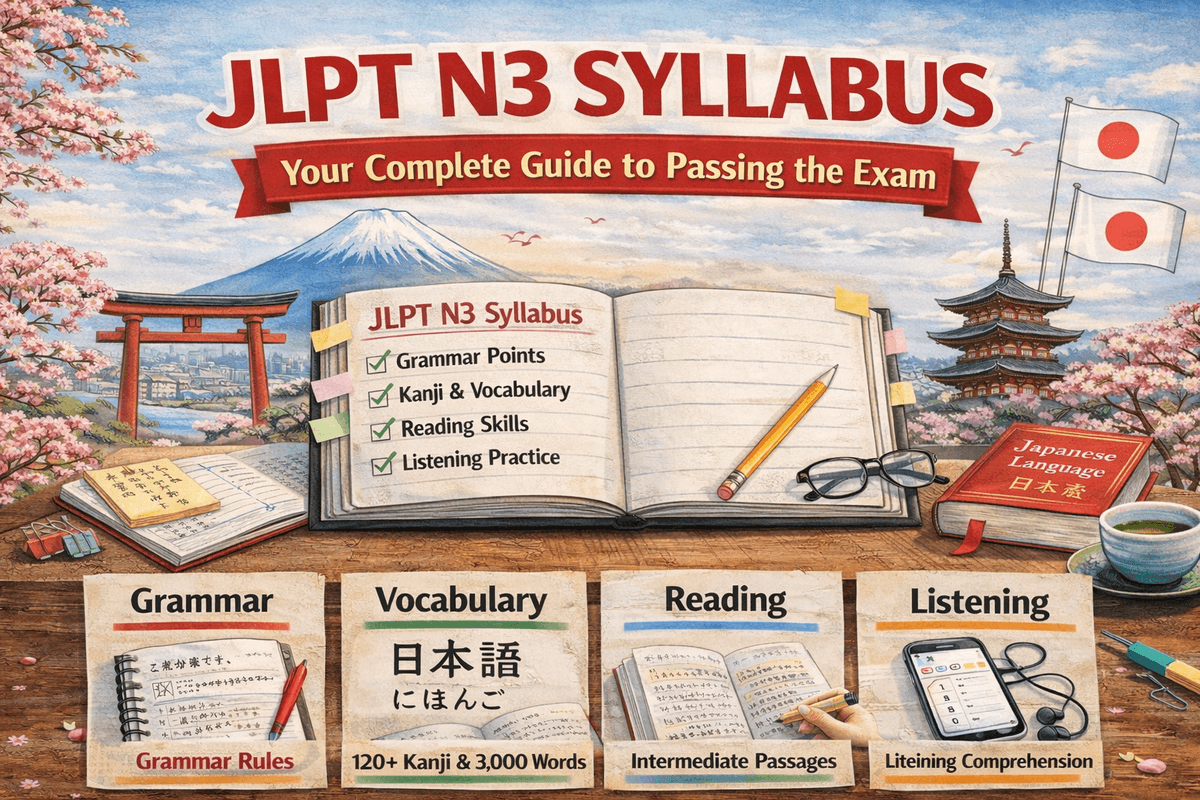
JLPT N3 Syllabus: Your Complete Guide to Passing the Exam
Published: 2026-04-20 05:45:17
The JLPT N3 syllabus marks the bridge from beginner to intermediate Japanese, testing your ability to handle everyday conversations, read simple articles, and understand spoken Japanese in practical contexts. According to the official JLPT website (jlpt.jp/e/about/levelsummary.html), N3 requires knowledge of approximately 650 kanji, 3,700 vocabulary words, and grammar patterns for expressing opinions, describing experiences, and grasping nuances in daily life or work settings.
This level assumes you've mastered N4/N5 basics and builds toward N2 fluency. Preparation typically takes 300-600 hours, depending on your starting point. Whether you're aiming for jobs in Japan, study abroad, or personal growth, cracking the JLPT N3 syllabus opens doors. At TLS-The Japanese Language School in Laxmi Nagar, Delhi, our structured courses align perfectly with this syllabus, boasting high pass rates through expert-led classes and mock tests.
Ready to conquer JLPT N3? Enroll at TLS today!
Visit Us: 2/81-82, 2nd Floor, Lalita Park, Gali No - 2, Laxmi Nagar, New Delhi - 110092
Call Us: 918700956038
Email Us: tls@teamlanguages.com
Now, explore the detailed JLPT N3 syllabus breakdown from official sources.
JLPT N3 grammar guide → https://www.studyjapaneselanguage.com/blogs/jlpt-n3-grammar-guide
JLPT N3 Syllabus Breakdown
As you progress beyond the basics, the JLPT N3 level becomes a crucial milestone in your Japanese learning journey. This section will guide you through the complete syllabus breakdown, helping you understand what skills and knowledge are required at this stage.
The JLPT N3 serves as the intermediate "bridging" level, transitioning from basic classroom Japanese to more functional, real-world usage. To pass, you must demonstrate a balanced proficiency across three main scoring sections: Language Knowledge (Vocabulary/Grammar), Reading, and Listening.
Vocabulary in JLPT N3 Syllabus
Vocabulary forms the foundation of the JLPT N3 syllabus, expanding to 3,700 words double N4's scope for real-world use. Official guidelines emphasize themes like travel (旅行 ryokou), health (健康 kenkou), shopping (買い物 kaimono), work (仕事 shigoto), and hobbies (趣味 shumi).
Key areas include:
- Nouns for abstract concepts (e.g., 機会 kikai - opportunity).
- Verbs in various forms (e.g., 決める kimeru - to decide).
- Adjectives/adverbs for descriptions (e.g., 便利 benri - convenient).
- 650 kanji cumulative (150 new from N4): Compounds like 学校 (gakkou - school) with on/kun readings.
The SRMIST-style syllabi reinforce this with lists totaling ~3,700 entries. To master, group by theme—use Anki for spaced repetition. TLS students get curated vocab decks, accelerating retention by 40%.
JLPT N3 vocabulary list with meanings → https://www.studyjapaneselanguage.com/blogs/jlpt-n3-vocabulary-list
Grammar in JLPT N3 Syllabus
Grammar in the JLPT N3 syllabus introduces complexity, with 100 patterns for nuanced expression. Expect particles beyond basics, plus causative (させる saseru), passive (られる rareru), and conditional forms (~ば bai - if/when).
Core elements:
- Verb/adjective conjugations: Potential (食べられる taberareru - can eat), volitional (食べよう tabeyou - let's eat).
- Connectors: ~ながら (nagara - while), ~によると (ni yoru to - according to).
- Expressions for cause/result (e.g., ~ので node - because), comparisons (~より yori - than).
This covers 60-70% of the language knowledge section. Practice via sentence mining from NHK news. At TLS, weekly grammar drills ensure you apply these fluidly.
complete JLPT exam guide for all levels → https://www.studyjapaneselanguage.com/blogs/jlpt-exam-guide
Reading Comprehension in JLPT N3 Syllabus
Reading in the JLPT N3 syllabus ramps up to 300-400 character passages on news, emails, ads, or diaries. Per jlpt.jp, you must infer details, understand intent, and handle synonyms/antonyms.
Skills tested:
- Main idea supporting facts.
- Kanji/vocab in context (no furigana on complex terms).
- Logical flow, e.g., "Why did the event cancel?"
Examples from practice tests include short stories or schedules. Build stamina with 20-30 min daily reads from newspapers like Asahi Shimbun easy versions. TLS reading workshops simulate exam pressure.
Listening Comprehension in JLPT N3 Syllabus
Listening demands comprehension of 2-3 minute dialogues/monologues at near-natural speed, covering meetings, phone calls, announcements, or travel scenarios.
Focus areas:
- Grasping gist, specifics, speaker attitudes.
- Fill-in-blanks, multiple choice on implications.
- Accents/variations in polite speech.
Official audio samples emphasize everyday/work topics. Shadowing techniques work wonders—listen-repeat daily. TLS provides recorded sessions with feedback.
JLPT exam format 2026 updated → https://www.studyjapaneselanguage.com/blogs/jlpt-exam-format-2026
Writing in JLPT N3 Syllabus
While not a scored section, writing supports reading/grammar: Compose 80-100 character essays on opinions (e.g., "My favorite season") using proper structure.
Requirements:
- Coherent paragraphs with topic sentences.
- Accurate kanji (650 ), hiragana/katakana mix.
- Varied grammar/vocab from syllabus.
Practice outlining then writing. TLS homework includes peer-reviewed essays.
Speaking in JLPT N3 Syllabus
Speaking isn't tested but integral: Hold 5-10 min convos on experiences, plans, debates using JLPT N3 syllabus grammar.
Practice:
- Role-plays: Job interviews, directions.
- Descriptions: Events, comparisons.
- Questions: どう思いますか? (Dou omoimasu ka? - What do you think?).
TLS conversation clubs build confidence.
JLPT levels explained (N5 to N1) → https://www.studyjapaneselanguage.com/blogs/jlpt-exam-levels
JLPT N3 Exam Format & Scoring
The JLPT N3 syllabus aligns with a 170-min exam (no break):
- Language Knowledge (Vocab/Grammar/Reading): 105 min, 100 questions, max 120 pts.
- Listening: 40 min, 30-40 questions, max 60 pts.
- Total: 180 pts; pass at 95 overall 19/section min.
Tests: July/Dec 2026 (register via jlpt.jp). Results in 2 months. Validity: 2 years for most uses.
TLS N3 crash courses guarantee 90% pass rates—spots filling fast!
Visit Us: 2/81-82, 2nd Floor, Lalita Park, Gali No - 2, Laxmi Nagar, New Delhi - 110092
Call Us: 918700956038
Email Us: tls@teamlanguages.com
How to Prepare for JLPT N3 Syllabus
Preparing for JLPT N3 means moving from basic Japanese to functional intermediate fluency. At this level, you’re expected to master ~650 kanji, ~3,750 vocabulary words, and 180–200 grammar points, as highlighted by platforms like Migaku.
The N3 exam acts as a bridge between classroom learning and real-world Japanese usage, according to Japanese-Language Proficiency Test.
1. Master the Core Syllabus
Kanji
You’ll learn ~370 new kanji beyond N4. Focus on jukugo (compound words) because readings often change in combinations.
Vocabulary
Expect more abstract and situational vocabulary related to emotions, workplace, and social interactions.
Grammar
N3 introduces nuanced structures like:
- Cause & effect: ~おかげで (positive cause) vs ~せいで (negative cause)
- Formal vs casual expressions
- Complex sentence linking
free JLPT practice tests N5 to N1 → https://www.studyjapaneselanguage.com/blogs/free-jlpt-practice-tests-online-n5-to-n1
2. Strategic 6–12 Month Study Plan
Months 1–3: Foundation Building
- Learn 10–15 words 5–7 kanji daily
- Focus on basics using: Shin Kanzen Master / Sou Matome
- Start spaced repetition (Anki)
Months 4–6: Application Phase
- Begin active reading practice
- Use real-world content like NHK News
- Practice grammar pattern drills
Apps: Bunpro, Readlang
Months 7–9: Intensive Practice
- Focus on listening at natural speed
- Use shadowing techniques
- Resources: JapanesePod101, Nihongo no Mori
Months 10–12: Mock Test Phase
- Take full-length timed tests weekly
- Analyze mistakes deeply
- Improve speed and accuracy
JLPT test paper with answers PDF → https://www.studyjapaneselanguage.com/blogs/jlpt-test-paper
3. Essential Study Resources
Textbooks
- Shin Kanzen Master N3 (comprehensive)
- Try! JLPT N3 (context-based learning)
Apps
- Anki (spaced repetition)
- Kanji Study (kanji compounds)
Reading Practice
- NHK News Web Easy
- Japanese Graded Readers (Level 3–4)
Listening Practice
- JapanesePod101
- Nihongo no Mori
best JLPT preparation books and resources → https://www.studyjapaneselanguage.com/blogs/jlpt-preparation-books-and-online-resources
4. Critical Exam Tips
1. Avoid Word-by-Word Translation
Focus on overall meaning, especially in reading passages.
2. Sectional Cut-Off Matters
You must pass each section individually (minimum ~19/60). Strong vocabulary won’t compensate for weak listening.
3. Active Recall > Passive Study
Use sentence-based flashcards to understand grammar kanji in context.
4. Speed is Key
The reading grammar section has strict timing (~70 minutes), so practice under exam conditions.
best JLPT preparation books and resources → https://www.studyjapaneselanguage.com/blogs/jlpt-preparation-books-and-online-resources
5. Common Pitfalls to Avoid
- Ignoring kanji revision
- Poor listening practice (not adapting to natural speed)
- Memorizing without context
- Lack of mock test analysis
6. Smart Strategy for Success
Consistency beats intensity. Study daily, revise weekly, and test monthly.
If you follow a structured plan, track performance, and focus on real-world usage, cracking JLPT N3 becomes realistic within 6–12 months.
For better results, many learners use guided mock tests and structured roadmaps to push scores above 100 consistently.
JLPT registration 2026 last date → https://www.studyjapaneselanguage.com/blogs/jlpt-registration-2026
FAQs on JLPT N3 Syllabus
What’s covered in JLPT N3 syllabus?
JLPT N3 syllabus includes 3,700 vocab words, 650 kanji, 100 grammar patterns, reading 300-char passages, and listening to 2-3 min dialogues for intermediate daily/work use.
How many kanji for JLPT N3 syllabus?
650 cumulative (150 new), focusing on readings/meanings in compounds like 必要 (hitsuyou - necessary).
JLPT N3 vs N4 differences?
N3 doubles vocab/kanji, adds complex grammar (causative/passive), longer reading/listening vs N4's basics.
Official JLPT N3 syllabus sources?
jlpt.jp/e/about/levelsummary.html practice workbooks. SRMIST PDFs for breakdowns.
Prep time for JLPT N3 syllabus?
300-600 hours; 6-12 months post-N4. TLS accelerates to 4-6 months.
Is writing in JLPT N3 syllabus tested?
Indirectly via grammar/reading; practice short essays for support.
Start Your JLPT N3 Journey at TLS
Don't just study the JLPT N3 syllabus—master it with TLS-The Japanese Language School. Our Laxmi Nagar experts offer small batches, live practice, and 2026 exam guarantees. Transform "JLPT dreams" into certificates!
Visit Us Today: 2/81-82, 2nd Floor, Lalita Park, Gali No - 2, Laxmi Nagar, New Delhi - 110092
Call Us: 918700956038
Email Us: tls@teamlanguages.com
Enroll now—first class free trial!