
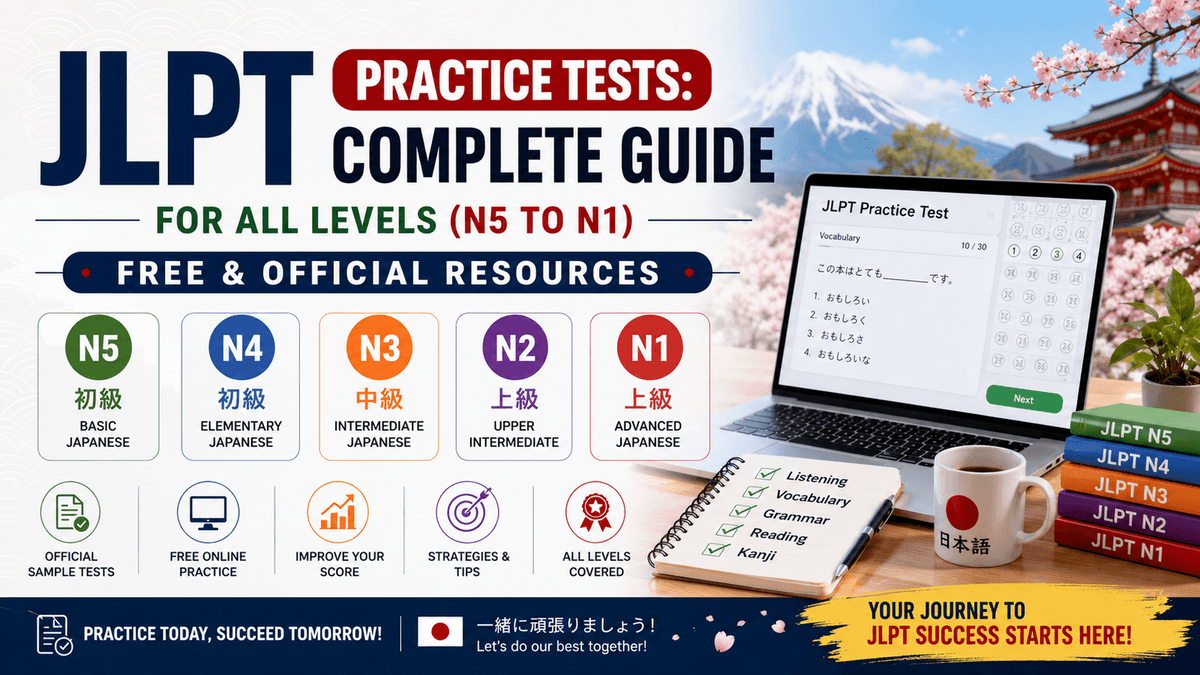
JLPT Practice Tests: Complete Guide for All Levels (N5 to N1) — Free & Official Resources
Published: 2026-06-10 12:07:40
Looking for the best JLPT practice tests online? Whether you're a beginner targeting N5 or an advanced learner aiming for N1, this comprehensive guide covers official sample questions, free online mock tests, exam formats, study tips, and everything you need to pass the Japanese Language Proficiency Test on your first attempt.
Learn everything about the JLPT India exam, including dates, registration, fees, and test centres.
What Is the JLPT and Why Do Practice Tests Matter?
The Japanese Language Proficiency Test (JLPT) is the world's most recognised standardised Japanese language certification for non-native speakers. Administered jointly by the Japan Foundation and Japan Educational Exchanges and Services (JEES), it is accepted globally by universities, employers, and immigration authorities as proof of Japanese language ability.
The JLPT is held twice a year — in July and December — across test centres worldwide, including multiple cities in India. The exam is divided into five levels:
| Level | Standard | Approximate Vocabulary | Approximate Kanji |
| N5 | Beginner | 800 | 100 |
| N4 | Elementary | 1,500 | 300 |
| N3 | Intermediate | 3,000 | 600 |
| N2 | Upper-Intermediate | 6,000 | 1,000 |
| N1 | Advanced / Master | 10,000 | 2,000 |
So why are JLPT practice tests so critical to your success? The answer is simple: the JLPT doesn't just test what you know — it tests how quickly and accurately you can apply that knowledge under real exam conditions. Regular practice with JLPT mock tests, sample questions, and timed drills is the single most effective way to build both knowledge and exam stamina.
Follow this JLPT N5 study guide for Indian students to build a strong foundation in Japanese.
Official JLPT Sample Questions: What the Exam Actually Looks Like
The most reliable JLPT practice tests come directly from the official JLPT website (jlpt.jp). These sample questions are organised by level (N1 to N5) and cover one sample item for each question type found in the actual exam. While they offer a snapshot rather than a full mock test, they are invaluable for understanding the structure and style of questions you will face.
Here is a breakdown of what the official sample questions cover at each level:
JLPT N5 Sample Questions — Beginner Level
N5 is the entry point for Japanese learners. The official sample questions cover:
- Vocabulary (文字・語彙): Identifying correct readings of basic hiragana, katakana, and kanji words (approx. 100 kanji). Example: choosing the correct reading for simple characters like 日 (にち/ひ), 山 (やま), 人 (ひと).
- Grammar & Reading (文法・読解): Selecting appropriate grammar patterns for sentence completion using N5 structures such as は、が、を、に、で particles, verb conjugation (ます/です forms), and basic て-form constructions. Short reading passages of 50–100 words are included.
- Listening (聴解): Short dialogues and one-question audio clips testing comprehension of greetings, numbers, time, and everyday situations.
N5 Practice Test Format:
- Total duration: 90 minutes
- Vocabulary section: 20 minutes
- Grammar Reading section: 40 minutes
- Listening section: 30 minutes
- Passing score: 80/180 (with sectional minimums)
Master the JLPT N2 syllabus to improve your vocabulary, grammar, reading, and listening skills for the exam.
JLPT N4 Sample Questions — Elementary Level
N4 builds on N5, testing your ability to understand basic Japanese in everyday situations.
- Vocabulary: Recognising readings and meanings of approximately 300 kanji. Words related to daily life, emotions, and simple actions.
- Grammar: Sentence completion using structures like て-form connections, conditional forms (〜たら、〜ば), potential verbs, causative and passive voice at a basic level.
- Reading: Passages of 100–200 words including notices, short letters, and simple explanatory texts.
- Listening: Slightly longer dialogues requiring inference about situations, relationships, and actions.
N4 Practice Test Format:
- Total duration: 115 minutes
- Vocabulary section: 25 minutes
- Grammar Reading section: 55 minutes
- Listening section: 35 minutes
- Passing score: 90/180
JLPT N3 Sample Questions — Intermediate Level
N3 is the bridge between beginner and advanced Japanese. It is often considered the most competitive level for working professionals.
- Vocabulary: 3,000 words, including 600 kanji. Words appear in multiple readings and contexts.
- Grammar: Compound sentence structures, conjunctions (〜ので、〜のに、〜ながら), expressions of degree and contrast, and verb noun nominalisation patterns.
- Reading: Medium-length passages (200–400 words) from newspapers, advertisements, and instructional texts. Inference-based questions become common.
- Listening: Multi-turn dialogues and information retrieval from announcements.
N3 Practice Test Format:
- Total duration: 140 minutes
- Vocabulary section: 30 minutes
- Grammar Reading section: 70 minutes
- Listening section: 40 minutes
- Passing score: 95/180
Build a strong foundation with this complete Japanese vocabulary guide for beginners to advanced learners.
JLPT N2 Sample Questions — Business Level
N2 is widely recognised by Japanese employers and is often the minimum requirement for professional roles in Japan.
- Vocabulary: 6,000 words and 1,000 kanji. Complex compound words, formal and written vocabulary.
- Grammar: Advanced sentence patterns, honorific and humble language (keigo basics), nuanced conjunctions, and expressions showing cause, contrast, and supposition.
- Reading: Longer passages (400–600 words) from news articles, essays, and reports. Questions test the ability to identify the author's intent and main argument.
- Listening: Lectures, formal conversations, and information-dense monologues. Requires note-taking strategies.
N2 Practice Test Format:
- Total duration: 155 minutes
- Grammar Reading section: 105 minutes
- Listening section: 50 minutes
- Passing score: 90/180
JLPT N1 Sample Questions — Master Level
N1 is the highest JLPT level, representing near-native comprehension across all contexts — academic, professional, literary, and conversational.
- Vocabulary: 10,000 words, 2,000 kanji including rare and literary characters.
- Grammar: Complex, nuanced patterns including written vs. spoken distinctions, classical grammar elements, and idiomatic usage.
- Reading: Long, dense texts (600–900 words) from novels, academic papers, and opinion columns. Questions require deep inference, evaluation of tone, and comprehension of implicit meaning.
- Listening: Complex discussions, debates, and extended monologues requiring synthesis of multiple pieces of information.
N1 Practice Test Format:
- Total duration: 165 minutes
- Grammar Reading section: 110 minutes
- Listening section: 55 minutes
- Passing score: 100/180
Discover the top benefits of learning Japanese for career growth, higher education, and global opportunities.
Free JLPT Practice Tests Online: Top Resources
Beyond the official sample questions, several platforms offer comprehensive free JLPT practice tests online that simulate the full exam experience:
1. Official JLPT Sample Questions (jlpt.jp)
The gold standard. Covers one sample per question type for all five levels. Best used to understand question format before moving to full mock tests. 👉 Try Official Sample Questions
2. Nihonez JLPT Online Mock Tests (nihonez.com)
Nihonez provides full-length JLPT mock exams for all levels (N5 to N1) with instant results, detailed explanations, and timed exam simulation. Their platform also features a JLPT Boost tool that gives you personalised question sets based on your weak areas — ideal for targeted JLPT practice tests for self-study.
Key features include:
- Authentic questions modelled on real past exams
- Timed practice simulating actual test conditions
- Instant feedback with answer explanations
- Section-specific drills (vocabulary, grammar, reading, listening)
- Adaptive learning through JLPT Boost
Learn everything about the JLPT (Japanese Language Proficiency Test) including levels, syllabus, and exam pattern.
3. JLPT Official Practice Workbook (PDF)
The Japanese-Language Proficiency Test Official Practice Workbook is available for purchase through the official JLPT website. These are the closest thing to official JLPT practice tests PDF format, created by the same organisation that administers the actual exam.
How to Use JLPT Practice Tests Effectively: 7 Proven Study Tips
Getting access to jlpt practice tests for all levels is only half the battle. How you use them determines your result.
1. Start with the Official Sample Questions
Before attempting any full-length mock exam, review the official sample questions for your target level. This familiarises you with question types and removes the element of surprise on exam day.
2. Always Practise Under Timed Conditions
The JLPT is as much a speed test as a knowledge test. From day one, practise with the correct time limits. N5 learners have 90 minutes; N1 candidates have 165 minutes. Build that exam-day endurance.
3. Take at Least One Full-Length Mock Test Per Week
Jlpt timed practice tests free platforms like Nihonez allow you to simulate the complete exam experience. Do this weekly during the final six to eight weeks of preparation.
4. Analyse Every Wrong Answer
Your score matters less than understanding why you got something wrong. Keep a mistake journal. Tag errors by category — was it vocabulary, grammar, reading speed, or listening focus? Use that data to direct your next study session.
5. Build Vocabulary Systematically
JLPT vocabulary practice tests reveal your weakest word categories. Use flashcard apps alongside your mock tests to systematically expand vocabulary. For N5–N4, focus on everyday words. For N3 and above, build compound words and formal vocabulary.
6. Develop Listening Strategies
For JLPT listening practice tests online, resist the urge to understand every word. Train yourself to catch the main idea, key numbers, names, and the final question — that is what the test actually rewards.
7. Immerse Daily Beyond Practice Tests
Anime, J-dramas, NHK news, and Japanese podcasts complement your jlpt grammar practice tests by exposing you to natural language patterns that textbooks cannot capture. TLS students are encouraged to integrate immersion techniques alongside structured classroom preparation.
Explore the top JLPT institutes in Delhi to find the best coaching for N5 to N1 preparation
JLPT Preparation at TLS — The Japanese Language School, Delhi
If you are serious about cracking the JLPT — whether at N5, N4, N3, N2, or N1 — structured coaching alongside JLPT practice tests makes a measurable difference in your success rate.
TLS (Team Language School) is Delhi's trusted Japanese language institute, offering JLPT-oriented courses from beginner to advanced levels. Here's what makes TLS the preferred choice for thousands of Japanese learners across Delhi NCR:
✅ JLPT-Focused Curriculum — Each course is mapped to the JLPT syllabus with grammar, vocabulary, reading, and listening modules aligned to your target level.
✅ Expert Faculty — Learn from experienced Japanese language trainers, including native Japanese teachers, who understand exactly what the JLPT examiners are looking for.
✅ Regular Mock Tests — TLS conducts in-class JLPT mock practice tests and review sessions so you are always exam-ready.
✅ Online & Offline Classes — Study at our Laxmi Nagar centre or join our live online Japanese language course from anywhere in India.
✅ Japan Visa Assistance — TLS provides end-to-end support for students planning to study or work in Japan, including documentation, COE guidance, and visa application help.
✅ JLPT Registration Guidance — Not sure how to register for the JLPT? Our counsellors guide you through the entire process. Visit our JLPT Registration Guide for detailed steps.
Courses Available:
- Basic Japanese N5
- Intermediate Japanese N4
- Pre-Advance Japanese N3
- Advance Japanese N2
- Super Advance Japanese N1
- Online Japanese Language Course
- Conversation Classes in Japanese (Kaiwa)
Ready to start? Visit our Admission Page or explore Japanese Language Course Fees in Delhi to find the right plan for your budget.
📍 Visit TLS — The Japanese Language School
Address: 2/81-82, 2nd Floor, Lalita Park, Gali No - 2, Laxmi Nagar, New Delhi – 110092
📞 Call Us: 91 8700956038 📧 Email Us: tls@teamlanguages.com 🌐 Website: www.teamlanguages.com
JLPT Practice Test Schedule: When Should You Start?
Planning your jlpt practice tests for all levels timeline around the actual exam dates is essential. The 2026 JLPT exam dates are:
- First Test: Sunday, 5 July 2026
- Second Test: Sunday, 6 December 2026
Here is a recommended practice test schedule leading up to the July exam:
| Weeks Before Exam | Focus |
| 12–10 weeks | Master core vocabulary and grammar; attempt one practice section per week |
| 9–7 weeks | Full-length jlpt online mock tests with score; identify weak sections |
| 6–4 weeks | Targeted section drills; vocabulary and grammar practice tests daily |
| 3–2 weeks | Two full-length mock tests per week; listening practice tests every other day |
| Final week | Light review only; revisit mistake journal; rest well before exam day |
For students in Delhi who are also preparing for JLPT July 2026, visit our dedicated page: JLPT July 2026 Guide
JLPT Practice Tests vs. NAT Test: Which Should You Focus On?
Many Indian students ask whether they should practise for the JLPT or the NAT Test (Nihongo Achievement Test). Both are Japanese language proficiency examinations, but they serve different purposes.
- JLPT is globally recognised, accepted for visa applications, employment in Japan, and university admissions worldwide.
- NAT Test is held more frequently in India (monthly) and is popular for SSW visa applicants.
If your goal is working or studying in Japan, or getting a job at a Japanese company in India, JLPT certification is the stronger credential. You can read more about this in our detailed comparison: JLPT vs NAT Test
Related Resources from TLS
Explore these helpful articles and pages to support your JLPT journey:
- 📖 JLPT N5 Study Guide for Indian Students
- 📖 Free JLPT N5 Sample Questions with Answers
- 📖 JLPT N5 Kanji List
- 📖 JLPT N3 Kanji List
- 📖 JLPT N2 Syllabus
- 📖 How to Prepare for JLPT N5 in 30 Days
- 📖 JLPT Exam Dates and Registration 2026
- 📖 Best Online Courses for JLPT Exam Preparation
- 📖 Jobs in India for Japanese Language Speakers
- 📖 Salary After JLPT N2 in India and Japan
- 📖 JLPT Exam Centres in India
- 📖 Learn Hiragana: Japanese Alphabet Guide
Frequently Asked Questions (FAQs) About JLPT Practice Tests
Q1. Are official JLPT practice tests free?
Yes. The official JLPT website offers free sample questions for all levels (N1–N5) at jlpt.jp/e/samples/forlearners.html. These cover one sample question per test item type. For full-length official JLPT practice tests PDF, the Official Practice Workbook is available for purchase from the JLPT website.
Q2. Where can I find free JLPT practice tests online for all levels?
Several free platforms offer jlpt practice tests for all levels, including the official JLPT site and Nihonez (nihonez.com), which provides full-length N5 to N1 mock exams with instant results and explanations.
Q3. How many practice tests should I take before the JLPT exam?
Aim for a minimum of 6–8 full-length mock tests in the two months before the exam. Supplement these with daily section-specific jlpt vocabulary practice tests, jlpt grammar practice tests, and jlpt listening practice tests online.
Q4. What is the passing score for each JLPT level?
- N5: 80/180 | N4: 90/180 | N3: 95/180 | N2: 90/180 | N1: 100/180 You must also meet sectional minimum scores for each section — a high overall score does not compensate for a very low section score.
Q5. Can I skip JLPT levels? Do I need to pass N5 before taking N4?
No prerequisite is required. You can register for any level directly based on your current ability. Many learners start at N4 or N3 if they have prior Japanese study background.
Q6. Are JLPT practice tests available with audio for listening practice?
Yes. The official JLPT site and platforms like Nihonez include jlpt practice tests with audio files for listening comprehension practice. TLS also conducts listening-focused sessions during classroom preparation.
Q7. Is JLPT N2 required to work in Japan?
N2 is the most commonly requested level by Japanese employers, though some roles accept N3 and others require N1. For detailed career information, read: Job Opportunities After JLPT Certification
Q8. How long does it take to prepare for JLPT N5?
With consistent study (1–2 hours per day), most beginners can reach N5 level in 3–4 months. A structured course at TLS covers N5 in approximately 3 months with regular practice tests built in.
Q9. Does TLS provide JLPT preparation coaching in Delhi?
Yes. TLS offers dedicated JLPT preparation courses for all levels at their Laxmi Nagar centre in Delhi and online. Visit Japanese Language Classes in Delhi for more details.
Q10. When is the next JLPT exam in India?
The next JLPT exams in 2026 are scheduled for 5 July 2026 and 6 December 2026. Check our guide: JLPT July 2026 and JLPT Overseas Test Centres
🎯 Start Your JLPT Preparation Today with TLS
Whether you are a complete beginner starting with free JLPT N5 practice tests or an advanced learner tackling JLPT N1 full-length practice tests, the path to JLPT success is built on consistent, structured practice — and expert guidance makes all the difference.
TLS – The Japanese Language School has helped hundreds of students across Delhi NCR achieve their JLPT goals, secure jobs at Japanese companies, and pursue their dreams of studying or working in Japan.
📍 Visit Us: 2/81-82, 2nd Floor, Lalita Park, Gali No - 2, Laxmi Nagar, New Delhi – 110092 📞 Call: 91 8700956038 📧 Email: tls@teamlanguages.com
👉 Enroll Now → 👉 Explore All Courses → 👉 Take the Free Japanese Quiz →