
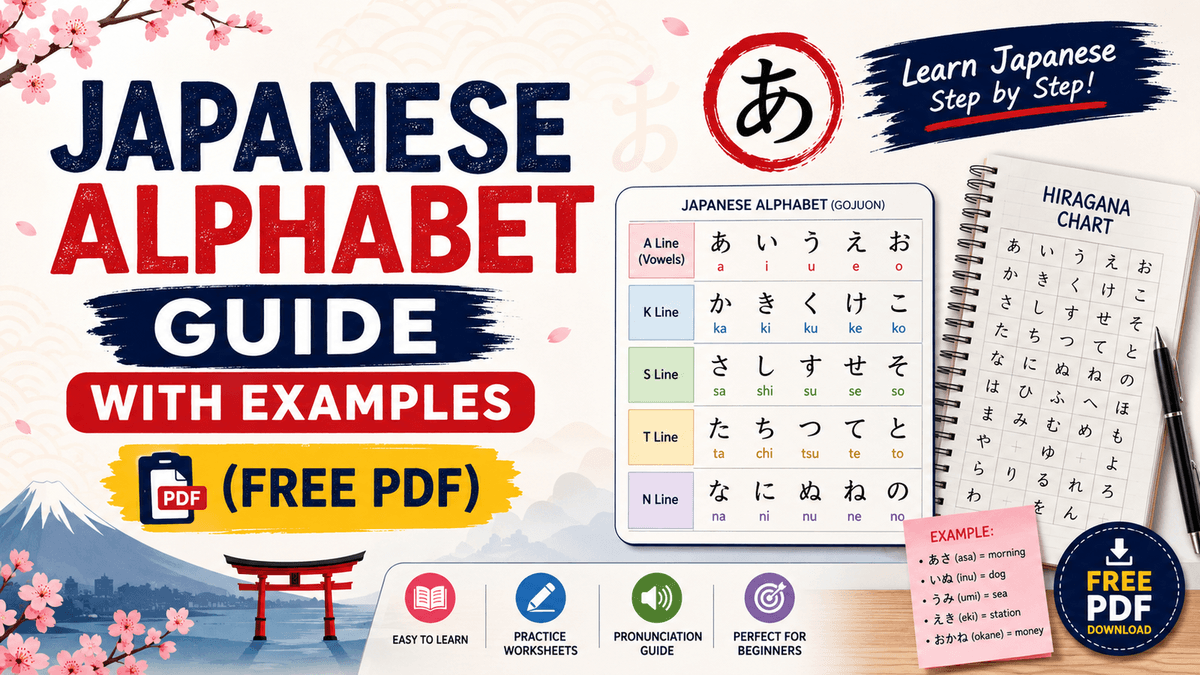
Japanese Alphabet Guide with Examples (Free PDF)
Published: 2026-05-12 09:26:05
Learning the Japanese language begins with understanding its writing system. If you are a beginner, this Japanese alphabet guide with examples (free PDF) will help you build a strong foundation. Unlike English, Japanese does not use a single A–Z alphabet. Instead, it uses three scripts: Hiragana, Katakana, and Kanji.
In this complete guide, you will learn how the Japanese alphabet works, how to read and write basic characters, and how to download useful PDFs for practice. This article is designed to be SEO-friendly, beginner-friendly, and conversion-focused for learners looking to master Japanese step by step.
If you are searching for the best Japanese language institute in Delhi, this guide will help you find the right best Japanese language institute in Delhi for JLPT preparation, affordable courses, and career opportunities.
Understanding the Japanese Alphabet System
Many beginners search for “Japanese letters A–Z,” but Japanese doesn’t use a single alphabet like English. Instead, it relies on a phonetic and logographic writing system made up of three distinct scripts. Each script has a specific role, and together they form the complete Japanese writing system.
The Three Writing Systems
- Hiragana (ひらがな) – A phonetic script used for native Japanese words, grammar particles, and sentence endings. It is the first script beginners should learn.
- Katakana (カタカナ) – Also phonetic, but mainly used for foreign words, loanwords, brand names, and scientific terms.
- Kanji (漢字) – Logographic characters borrowed from Chinese, where each symbol carries meaning and often multiple pronunciations.
Where Should Beginners Start?
If you are learning Japanese from scratch, the ideal order is:
- Hiragana – Build your reading and pronunciation foundation
- Katakana – Understand modern vocabulary and foreign terms
- Kanji – Gradually learn characters for deeper comprehension
Mastering Hiragana and Katakana first will make it much easier to progress into Kanji and overall fluency.
Learn how to read katakana easily with this simple guide that explains characters, pronunciation, and basic usage for beginners.
Japanese Alphabet in Order
The Japanese writing system follows a well-organized structure known as the “Gojuon” system, which arranges characters based on vowel and consonant combinations. This system makes it easier for learners to understand pronunciation patterns and memorize characters logically.
Basic Vowels
The foundation of the Japanese alphabet begins with five core vowel sounds:
- A (あ)
- I (い)
- U (う)
- E (え)
- O (お)
These vowels are essential because every other character in the system is built by combining a consonant with one of these vowel sounds.
Consonant Vowel Combinations
Once you understand the vowels, the next step is learning how consonants combine with them to form new sounds:
- K-line: Ka (か), Ki (き), Ku (く), Ke (け), Ko (こ)
- S-line: Sa (さ), Shi (し), Su (す), Se (せ), So (そ)
- T-line: Ta (た), Chi (ち), Tsu (つ), Te (て), To (と)
- N-line: Na (な), Ni (に), Nu (ぬ), Ne (ね), No (の)
This pattern continues across other consonant groups, creating a complete and structured sound chart.
How It Relates to A–Z
While many learners search for the Japanese alphabet A to Z Hiragana, it’s important to understand that Japanese is not arranged like the English alphabet. Instead of individual letters, it uses syllables (sounds).
The Gojuon system provides a similar sense of order, making it the closest equivalent to an “A–Z” format in Japanese.
If you are starting Japanese, this guide on how to read hiragana will help you learn basic characters, pronunciation, and reading practice from scratch.
Japanese Alphabet to English (Comparison)
While Japanese does not have a direct A–Z alphabet like English, beginners can still understand it through sound-based comparisons. Japanese characters represent syllables (a consonant vowel sound), not individual letters. This makes the system different but also more consistent in pronunciation.
Simplified Sound Comparison
Here’s how some English letters relate to Japanese sounds:
- A → あ (a)
- B → ば (ba)
- K → か (ka)
- S → さ (sa)
- T → た (ta)
These examples show that Japanese builds sounds by combining consonants with vowels, rather than using standalone letters like English.
Important Things to Remember
- Japanese pronunciation is more consistent than English—each character usually has one fixed sound.
- Some sounds do not match perfectly. For example, “R” in Japanese (ら, り, る, れ, ろ) is pronounced somewhere between “R” and “L.”
- There are unique sounds like “tsu” (つ) and “fu” (ふ) that don’t have exact English equivalents.
Why This Comparison Helps
This type of comparison is useful for beginners searching for terms like “Japanese alphabet to English” or “Japanese letters A–Z.” It creates a familiar starting point, making it easier to begin reading and speaking Japanese.
However, to truly master pronunciation, learners should combine this approach with listening practice and repetition.
If you are wondering how long to study Japanese language, this guide explains realistic timelines, JLPT levels, and how much time you need to reach fluency based on your learning goals.
Hiragana: The Foundation of Japanese
Hiragana (ひらがな) is the most essential script in Japanese and the first step for every beginner. It is a phonetic writing system where each character represents a specific sound, making it easier to learn and pronounce compared to complex scripts like Kanji.
Why Hiragana is Important
Hiragana is widely used in everyday Japanese for:
- Basic words – Common vocabulary and native Japanese terms
- Grammar particles – Elements that define sentence structure (such as は, を, に)
- Sentence endings – Helping complete thoughts and express meaning clearly
Without Hiragana, it is almost impossible to read or form even the simplest Japanese sentences.
Examples of Hiragana in Use
- あ (a) – あさ (asa) = morning
- い (i) – いぬ (inu) = dog
- う (u) – うみ (umi) = sea
These examples show how Hiragana forms the building blocks of words and pronunciation.
How Hiragana Helps Beginners
Once you learn Hiragana, you can:
- Read basic Japanese sentences
- Understand pronunciation accurately
- Start forming your own words and phrases
Mastering Hiragana builds a strong foundation and makes it much easier to move on to Katakana and Kanji.
If you are a beginner in Japanese, this guide on learn hiragana and katakana will help you master both writing systems quickly with easy charts, pronunciation tips, and practice methods.
Katakana: For Foreign Words
Katakana (カタカナ) is the second phonetic script in Japanese and is mainly used to represent foreign words, borrowed terms, and modern vocabulary. While Hiragana is used for native expressions, Katakana helps Japanese speakers adapt words from other languages into their sound system.
Where Katakana is Used
Katakana plays an important role in everyday communication, especially in:
- Foreign names – People, countries, and cities (e.g., インド for India)
- English loanwords – Words borrowed from English and other languages
- Technical and scientific terms – Used in business, technology, and academia
- Brand names and emphasis – Sometimes used to highlight words
Examples of Katakana
- コーヒー (koohii) = coffee
- テレビ (terebi) = television
- コンピュータ (konpyuuta) = computer
These examples show how foreign words are adapted to fit Japanese pronunciation patterns.
If you are planning for the exam, this guide on how to prepare for JLPT exam explains level-wise strategy, study tips, and the best way to pass N5 to N1 successfully.
Why Katakana is Important
Katakana is essential for understanding modern Japanese, especially in areas like business, travel, media, and technology. Many commonly used words in Japan today come from English, so learning Katakana allows you to recognize and understand them quickly.
For learners, mastering Katakana after Hiragana significantly improves reading ability and helps in real-life conversations, making it a crucial step toward fluency.
Japanese Alphabet Guide with Examples A to Z
Although Japanese does not follow the traditional English A–Z system, it uses a well-structured phonetic arrangement that makes learning easier and more logical. This structure is based on sound patterns, where each character represents a syllable formed by combining a consonant with a vowel.
Phonetic Grouping (Gojuon Structure)
Here is a simplified breakdown of the Japanese alphabet in an “A to Z–like” format:
A-Line (Vowels)
- あ (a), い (i), う (u), え (e), お (o)
K-Line
- か (ka), き (ki), く (ku), け (ke), こ (ko)
S-Line
- さ (sa), し (shi), す (su), せ (se), そ (so)
T-Line
- た (ta), ち (chi), つ (tsu), て (te), と (to)
N-Line
- な (na), に (ni), ぬ (nu), ね (ne), の (no)
This pattern continues with additional groups like the H-line, M-line, Y-line, R-line, and W-line, forming a complete phonetic chart.
If you are a beginner in Japanese, this guide on how to learn hiragana and katakana will help you understand both writing systems easily with simple steps, charts, and practice tips.
Why This Structure Matters
This organized system is what learners commonly refer to as the “Japanese alphabet guide with examples A to Z.” While it is not a direct translation of English letters, it provides a familiar framework that helps beginners:
- Understand pronunciation patterns easily
- Memorize characters faster
- Build a strong reading foundation
By learning these sound groups step by step, you can quickly start recognizing words and forming basic Japanese sentences.
Free Japanese Alphabet PDF Download
To help you practice effectively, here are free downloadable resources:
These resources are ideal for beginners looking for a Japanese alphabet guide with examples PDF free download.
How to Learn Japanese Alphabet Fast
If you want to master the Japanese alphabet quickly, you need a structured and consistent approach. Since Japanese is based on sounds rather than letters, regular practice and repetition are key to building strong recognition and pronunciation skills.
1. Start with Hiragana
Begin your journey with Hiragana, as it forms the foundation of the Japanese language. Focus on learning 5–10 characters daily and revise them consistently to avoid forgetting.
2. Practice Writing Daily
Writing each character multiple times helps improve both memory and recognition. It also trains your hand to form characters correctly, which is important for long-term learning.
3. Use Flashcards for Quick Recall
Flashcards are one of the most effective tools for memorization. They allow you to test yourself regularly and reinforce what you’ve learned in a short amount of time.
4. Listen and Repeat
Pronunciation plays a crucial role in Japanese. Listen to native audio and repeat the sounds to develop accurate speaking skills and better listening comprehension.
5. Revise Every Day
Consistency matters more than speed. Even 15–20 minutes of daily revision can significantly improve your retention and confidence.
Pro Tip for Faster Learning
Combine all these methods—reading, writing, listening, and revision—to create a balanced study routine. This will help you learn the Japanese alphabet faster and more effectively, especially if you are aiming for exams like JLPT or NAT.
If you want to build strong Japanese vocabulary, this guide on learn kanji and Japanese words will help you understand kanji meanings, usage in daily sentences, and effective memorization techniques for faster learning.
Common Mistakes Beginners Make
When starting your journey with the Japanese alphabet, many learners unknowingly slow down their progress by making avoidable mistakes. Being aware of these can help you learn more efficiently and stay on the right track.
- Trying to learn Kanji first
Kanji is complex and should come after mastering Hiragana and Katakana. Starting with Kanji often leads to confusion and frustration. - Ignoring pronunciation
Japanese is a sound-based language, so correct pronunciation is essential. Mispronouncing sounds can lead to misunderstandings later. - Not practicing writing
Simply reading characters is not enough. Writing them regularly improves memory and helps you recognize them faster. - Skipping revision
Without consistent revision, it’s easy to forget what you’ve learned. Regular practice strengthens long-term retention.
Avoiding these common mistakes will make your learning process smoother, faster, and more effective.
Why Learn Japanese Alphabet?
Learning the Japanese alphabet is the first and most important step toward mastering the language. It builds the foundation for reading, writing, and speaking Japanese confidently.
Key Benefits
- Study Opportunities in Japan
Knowing the alphabet is essential for applying to Japanese universities and language programs. - Career Growth and Job Opportunities
Japanese language skills are in high demand across industries like IT, translation, tourism, and international business. - Understanding Anime and Japanese Culture
Learning the alphabet allows you to enjoy anime, manga, and Japanese media in their original form. - Better Business Communication
Japan is a global economic leader, and language skills can open doors to international business opportunities.
In short, mastering the Japanese alphabet is not just about learning characters—it’s about unlocking new academic, professional, and cultural possibilities.
If you want to improve your Japanese skills, this guide on top kanji learning tips will help you memorize kanji faster using radicals, daily practice methods, and effective memory techniques.
Learn Japanese with Experts
If you are serious about mastering Japanese, self-study alone may not be enough. A structured learning environment with expert guidance can significantly accelerate your progress. At TLS – The Japanese Language School, students receive comprehensive training designed to build fluency from the ground up.
What You Get
- Beginner to Advanced Courses (N5–N1)
A complete learning path covering all proficiency levels, from basic alphabet to advanced communication - Certified and Experienced Trainers
Learn from experts who provide clear explanations, real-life examples, and personalized guidance - Practical Speaking Sessions (Kaiwa Practice)
Improve your confidence with interactive sessions focused on real-world conversations - JLPT and NAT Exam Preparation
Get exam-focused training, mock tests, and strategies to successfully clear Japanese language certifications
Enrolling in a professional course ensures that you not only learn the Japanese alphabet but also develop the skills needed for speaking, reading, and writing fluently.
Contact Details
Visit Us
2/81-82, 2nd Floor, Lalita Park, Gali No - 2, Laxmi Nagar, New Delhi - 110092
FAQs
1. What is the Japanese alphabet?
The Japanese writing system consists of three scripts: Hiragana, Katakana, and Kanji. Hiragana and Katakana are phonetic (sound-based), while Kanji represents meanings and concepts.
2. Is there a Japanese alphabet A to Z?
No, Japanese does not follow the English A–Z system. Instead, it is based on syllables (sounds) organized in a structured pattern called the Gojuon chart.
3. How long does it take to learn Hiragana?
With consistent practice, most learners can master Hiragana in 1–2 weeks. However, full confidence in reading and writing may take a bit longer with regular revision.
4. Which script should I learn first?
You should start with Hiragana, then move to Katakana, and finally begin learning Kanji gradually.
5. Where can I download Japanese alphabet PDFs?
You can use the free downloadable PDFs provided in this guide, including Hiragana and Katakana charts, for structured practice.
6. Is Japanese difficult to learn?
Japanese can seem challenging at first, especially due to its writing system. However, with the right approach and consistency, beginners can quickly learn the basics.
7. Can I learn Japanese at home?
Yes, you can start learning at home using online resources, PDFs, and apps. However, guided learning from experts can speed up your progress significantly.
8. How many letters are there in the Japanese alphabet?
Japanese does not have “letters” like English. Instead, Hiragana and Katakana each have 46 basic characters, along with additional modified sounds.
9. What is the difference between Hiragana and Katakana?
Hiragana is used for native Japanese words and grammar, while Katakana is used for foreign words, loanwords, and names.
10. Do I need to learn Kanji to speak Japanese?
You can start speaking basic Japanese without Kanji, but for reading, writing, and advanced fluency, learning Kanji is essential.
Conclusion
This Japanese alphabet guide with examples free download provides everything you need to start your journey. By learning Hiragana and Katakana step by step and using the provided PDFs, you can build a strong foundation in Japanese.
For faster progress and expert guidance, consider joining a professional institute and take your learning to the next level.