japanese adjectives i adjectives vs na adjectives
Published: 2026-10-27 09:21:08
Japanese adjectives are the words that bring your sentences to life. They let you say that a ramen is delicious, a city is quiet, or your teacher is kind. But before you can use them with confidence, you need to understand one core idea: I-adjectives vs Na-adjectives.
In this beginner-friendly guide from TLS – The Japanese Language School, you will learn the difference between I adjectives and Na adjectives, how to conjugate each type, how to avoid common mistakes, and how these rules show up in the JLPT N5 and N4 exams. Every point comes with Japanese adjective examples and English translations.
For students planning to learn Japanese, choosing the right institute is important. Read our guide on how to choose a Japanese language institute in Delhi to make an informed decision.
What Are Japanese Adjectives? A Beginner's Guide to Japanese Grammar
An adjective describes a noun: its size, colour, feeling, quality or condition. In English, adjectives never change form (big, bigger, was big all keep "big" as the base word). In Japanese, adjectives behave more like verbs. They change their endings to show tense (present or past) and polarity (positive or negative).
This is why Japanese adjectives for beginners can feel tricky at first. The good news is that the system is very regular. Once you learn the Japanese adjective rules, you can apply them to hundreds of words.
Japanese adjectives are used in two main ways:
- Before a noun (attributive use): 高い山 (takai yama) – "a tall mountain"
- At the end of a sentence (predicative use): 山は高いです (yama wa takai desu) – "The mountain is tall."
If you are just starting out with Japanese grammar for beginners, adjectives are one of the first big topics you will meet, right after basic sentence patterns and particles.
📖 Want structured guidance? Our Japanese language course for beginners in Delhi walks you through grammar step by step, with a teacher who corrects you in real time.
Types of Japanese Adjectives: I-Adjectives vs Na-Adjectives
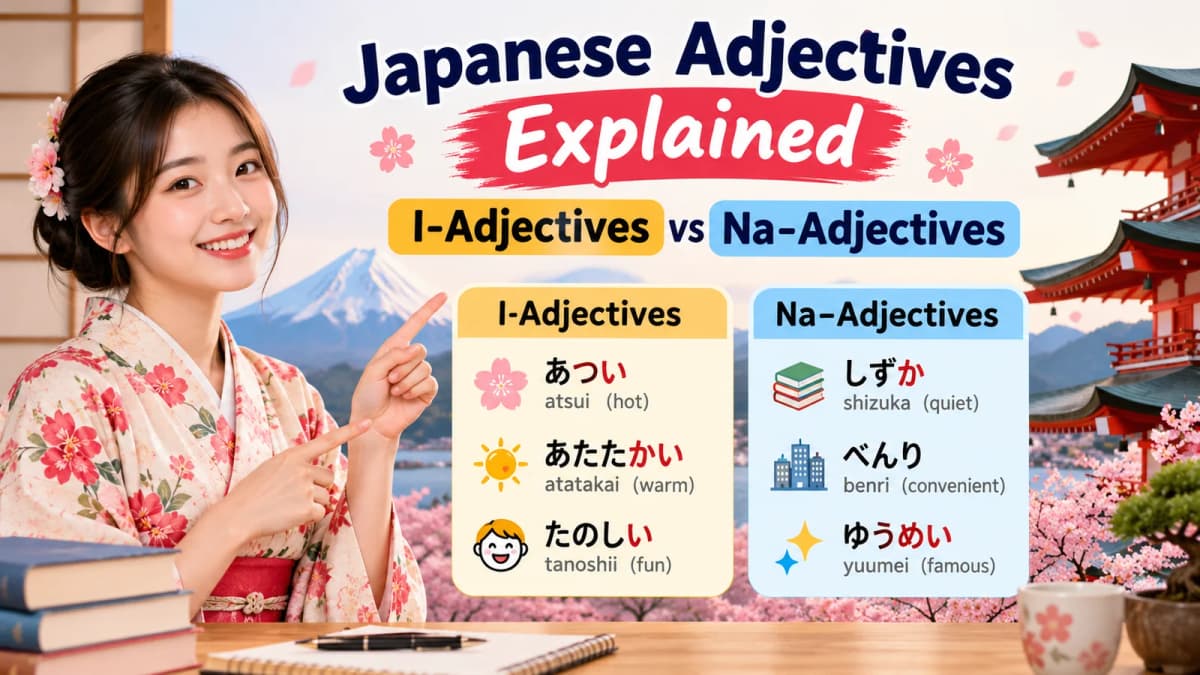
There are two types of Japanese adjectives:
| Feature | I-Adjectives (い形容詞) | Na-Adjectives (な形容詞) |
| Dictionary form ends in | Always い | Usually anything else |
| Before a noun | Adjective noun | Adjective な noun |
| Conjugation | The い itself changes | The adjective stays the same; だ/です changes |
| Example | 大きい (ookii) – big | 静か (shizuka) – quiet |
Understanding this table is the foundation of Japanese adjectives grammar. Let's look at each type in detail.
What Are I-Adjectives in Japanese? Rules and Examples
I-adjectives (い形容詞, i-keiyōshi) always end in the hiragana い. The ending is part of the word, and it is the part that changes when you conjugate.
Key rules for I-adjectives:
- They connect directly to a noun: 新しい本 (atarashii hon) – "a new book"
- They can end a sentence by themselves (plain form) or with です (polite form)
- To conjugate them, you drop the い and add new endings
Japanese I adjective examples:
| Japanese | Reading | Meaning |
| 高い | takai | expensive / tall |
| 安い | yasui | cheap |
| 新しい | atarashii | new |
| 古い | furui | old (not for people's age) |
| おいしい | oishii | delicious |
| 楽しい | tanoshii | fun |
| 忙しい | isogashii | busy |
| 大きい | ookii | big |
| 小さい | chiisai | small |
| 難しい | muzukashii | difficult |
Example sentences:
- このラーメンはおいしいです。 (Kono rāmen wa oishii desu.) – This ramen is delicious.
- 日本語は楽しいです。 (Nihongo wa tanoshii desu.) – Japanese is fun.
- 大きい犬がいます。 (Ookii inu ga imasu.) – There is a big dog.
Explore our Japanese language course for college students to start learning Japanese.
What Are Na-Adjectives in Japanese? Rules and Examples
Na-adjectives (な形容詞, na-keiyōshi), also called "adjectival nouns" or keiyō-dōshi, behave like nouns. They need the particle な when they come directly before a noun, and that is where their name comes from.
Key rules for Na-adjectives:
- Before a noun: adjective な noun → 静かな町 (shizuka na machi) – "a quiet town"
- At the end of a sentence: adjective です → この町は静かです。
- The adjective itself never changes; only だ/です changes
Japanese Na adjective examples:
| Japanese | Reading | Meaning |
| 静か | shizuka | quiet |
| きれい | kirei | pretty / clean |
| 元気 | genki | healthy / energetic |
| 有名 | yuumei | famous |
| 便利 | benri | convenient |
| 上手 | jouzu | skilled |
| 好き | suki | liked |
| 嫌い | kirai | disliked |
| 親切 | shinsetsu | kind |
| 大切 | taisetsu | important |
Example sentences:
- 先生は親切です。 (Sensei wa shinsetsu desu.) – The teacher is kind.
- きれいな花ですね。 (Kirei na hana desu ne.) – What a pretty flower.
- 有名なレストランに行きました。 (Yuumei na resutoran ni ikimashita.) – I went to a famous restaurant.
Working professionals can explore our Japanese language course in Delhi to learn Japanese.
Difference Between I-Adjectives and Na-Adjectives in Japanese
So what is the difference between I adjectives and Na adjectives? In short, it comes down to how they attach to nouns and how they conjugate.
- Ending: I-adjectives always end in い. Na-adjectives can end in almost anything.
- Noun connection: I-adjectives connect directly (takai kuruma). Na-adjectives need な (shizuka na heya).
- Conjugation: I-adjectives change their own ending (高い → 高くない). Na-adjectives stay the same, and the copula です/だ changes (静かです → 静かではありません).
- Origin: Na-adjectives are often derived from nouns or Chinese-origin words (kanji compounds), which is why they behave like nouns.
Think of it this way: I-adjectives do the work themselves, while Na-adjectives rely on です.
Japanese I-Adjectives vs Na-Adjectives: Examples in Sentences
Seeing both types side by side is the fastest way to learn how to use I adjectives and Na adjectives in Japanese.
| Type | Japanese | Romaji | English Translation |
| I-adj | この車は高いです。 | Kono kuruma wa takai desu. | This car is expensive. |
| I-adj | 高い車を買いました。 | Takai kuruma o kaimashita. | I bought an expensive car. |
| Na-adj | この部屋は静かです。 | Kono heya wa shizuka desu. | This room is quiet. |
| Na-adj | 静かな部屋を探しています。 | Shizuka na heya o sagashite imasu. | I'm looking for a quiet room. |
| I-adj | 今日は忙しいです。 | Kyou wa isogashii desu. | I'm busy today. |
| Na-adj | 東京は便利な町です。 | Toukyou wa benri na machi desu. | Tokyo is a convenient city. |
Notice the pattern: the I-adjective goes straight in front of the noun, while the Na-adjective needs な. These are essential Japanese adjectives examples with English translation to memorise early.
Learn Japanese from anywhere with our online Japanese language course.
How to Conjugate Japanese I-Adjectives in Present, Past, and Negative Forms
Japanese adjective conjugation is where many learners get nervous, but I-adjective conjugation is surprisingly simple. Here is how to conjugate Japanese I adjectives using 高い (takai – expensive):
| Form | Plain | Polite |
| Present positive | 高い | 高いです |
| Present negative | 高くない | 高くないです / 高くありません |
| Past positive | 高かった | 高かったです |
| Past negative | 高くなかった | 高くなかったです / 高くありませんでした |
The pattern:
- Negative: drop い → add くない
- Past: drop い → add かった
- Past negative: drop い → add くなかった
Other useful forms:
- て-form (connecting): drop い → add くて → 安くておいしい (yasukute oishii) – cheap and delicious
- Adverb form: drop い → add く → 早く起きます (hayaku okimasu) – I wake up early
⚠️ The Irregular I-Adjective: いい / よい
The adjective いい (good) is irregular. It conjugates from its older form よい:
| Form | Japanese |
| Present negative | よくない |
| Past | よかった |
| Past negative | よくなかった |
Never say いくない or いかった. This is one of the most common errors at the JLPT N5 level.
Explore the top Japanese language coaching institutes in Delhi to choose the right institute.
How to Conjugate Japanese Na-Adjectives in Present, Past, and Negative Forms
For Na-adjectives, the adjective stays untouched. Only the ending (だ / です) changes. Here is how to conjugate Japanese Na adjectives using 静か (shizuka – quiet):
| Form | Plain | Polite |
| Present positive | 静かだ | 静かです |
| Present negative | 静かじゃない / 静かではない | 静かじゃないです / 静かではありません |
| Past positive | 静かだった | 静かでした |
| Past negative | 静かじゃなかった / 静かではなかった | 静かじゃなかったです / 静かではありませんでした |
Other useful forms:
- て-form: adjective で → 静かできれいな町 (shizuka de kirei na machi) – a quiet and pretty town
- Adverb form: adjective に → 静かに話してください (shizuka ni hanashite kudasai) – please speak quietly
These Japanese adjectives present, past and negative forms are the same for every Na-adjective, so you only need to learn the pattern once.
Learn popular expressions with these common Japanese phrases used in anime.
Japanese Adjective Grammar Rules Every Beginner Should Know
Here are the most important Japanese adjective rules for beginners. Keep this checklist handy:
- Two types only. Every adjective is either an I-adjective or a Na-adjective.
- I-adjectives end in い; they conjugate by changing い.
- Na-adjectives need な before a noun.
- Adjectives can be the predicate. Unlike English, you do not need a "be" verb: 高いです is complete.
- Adjectives never take が/は by themselves as the subject. The noun takes the particle: 犬は大きいです。
- Use て-form to link adjectives: 安くて、おいしい (I-adj), 静かで、きれい (Na-adj).
- Use the adverb form to describe verbs: 早く走る (run quickly), きれいに書く (write neatly).
- Intensifiers: とても (very), ちょっと (a little), あまり negative (not very) → あまり高くないです。
- Comparisons: AはBより〜です → 東京は大阪より大きいです。
- Desires and likes: 好き (like) and 嫌い (dislike) are Na-adjectives, so you say 犬が好きです, not 犬を好きです.
Mastering this list will take you a long way in Japanese language grammar lessons and everyday speaking.
Start your journey with our guide to learning Japanese as a complete beginner.
Common Mistakes to Avoid When Using Japanese Adjectives
Even motivated learners trip over the same errors. Watch out for these:
1. Using な with I-adjectives ❌ 高いな車 → ✅ 高い車
2. Forgetting な with Na-adjectives ❌ 静か部屋 → ✅ 静かな部屋
3. Conjugating Na-adjectives like I-adjectives ❌ 静かくない → ✅ 静かじゃない
4. Conjugating いい incorrectly ❌ いくない → ✅ よくない
5. The "ends in い" trap. Not all adjectives ending in い are I-adjectives! Some very common words are Na-adjectives that just look like I-adjectives:
- きれい (pretty / clean)
- 有名 (famous) – no い at the end, but often confused
- きらい (嫌い) (dislike)
- 嫌い and きれい are the classics
Their negatives are きれいじゃない and きらいじゃない, not きれくない.
6. Adding です to past negative incorrectly. Say 高くなかったです (not 高くないでした).
Learn Japanese from anywhere in India with our online Japanese language course.
Common Japanese I-Adjectives and Na-Adjectives with English Meanings
Here is a ready-to-use Japanese adjectives list for beginners, with Japanese adjectives with English meanings grouped by type.
Common I-Adjectives
| Japanese | Reading | English |
| 暑い | atsui | hot (weather) |
| 寒い | samui | cold (weather) |
| 長い | nagai | long |
| 短い | mijikai | short |
| 明るい | akarui | bright |
| 暗い | kurai | dark |
| 速い / 早い | hayai | fast / early |
| 遅い | osoi | slow / late |
| 面白い | omoshiroi | interesting / funny |
| つまらない | tsumaranai | boring |
Common Na-Adjectives
| Japanese | Reading | English |
| 簡単 | kantan | easy / simple |
| 大変 | taihen | tough / serious |
| 丈夫 | joubu | sturdy |
| 賑やか | nigiyaka | lively |
| 暇 | hima | free (time) |
| 好き | suki | like |
| 下手 | heta | poor at |
| 綺麗 | kirei | beautiful |
| 無理 | muri | impossible |
| 大丈夫 | daijoubu | okay / fine |
Looking for downloadable practice sheets? Search for a Japanese adjectives list PDF, or try Japanese adjectives explained quizlet decks for flashcard drills. If you are just starting with reading, check adjectives in Japanese hiragana too, and brush up on Na-adjectives Japanese basics.
How to Use Japanese Adjectives in Everyday Conversations
Knowing the rules is only half the journey. Here are common Japanese adjectives for everyday conversation and how to use them naturally.
Describing food
- このカレーはおいしいですね。 – This curry is delicious.
- ちょっと辛いです。 – It's a little spicy.
Describing people
- 田中さんは親切です。 – Mr. Tanaka is kind.
- 彼女は優しくて、面白いです。 – She is gentle and funny.
Need more vocabulary? Here are Japanese adjectives to describe a person.
Describing places
- この町は静かで、きれいです。 – This town is quiet and pretty.
- 東京は人が多くて、にぎやかです。 – Tokyo has lots of people and is lively.
Asking opinions
- 日本語は難しいですか。 – Is Japanese difficult?
- いいえ、あまり難しくないです。 – No, it's not very difficult.
Easy way to learn Japanese adjectives:
- Learn adjectives in pairs of opposites (大きい/小さい, 高い/安い).
- Always memorise the type (I or Na) with the word.
- Make 3 sentences for every new adjective.
- Practise speaking with a teacher or partner every week.
At TLS, our Japanese language classes include speaking drills so that adjective patterns become automatic.
Explore our Japanese language courses in Delhi to start learning Japanese.
Japanese Adjectives for JLPT N5 and N4 Exam Preparation
Adjectives appear in almost every section of the exam. If you are aiming for Japanese adjectives for JLPT N5, you should be able to:
- Recognise and use about 30 I-adjectives and 20 Na-adjectives
- Apply all four conjugations (present, negative, past, past negative)
- Use adjectives before nouns with correct な
- Link adjectives using て-form
- Make comparisons with より and いちばん
At JLPT N4, expect more complex patterns, such as:
- Adjective すぎる (too much): 高すぎる – too expensive
- Adjective そう (looks like): おいしそう – looks delicious
- Adjective く / に なる (become): 寒くなる – it gets cold; 静かになる – it gets quiet
- Adjective く / に する (make): 部屋をきれいにする – tidy the room
- JLPT adjective conjugation rules applied in longer sentences
JLPT N5 I adjectives and Na adjectives questions often test the exact traps listed earlier: いい → よくない, きれい being a Na-adjective, and the correct negative forms. Regular Japanese grammar practice for JLPT N5 and a clear study plan make a huge difference. TLS's exam-focused Japanese grammar lessons for JLPT N5 and N4 are designed around this.
Check our guide to Japanese language course fees in Delhi to understand course costs.
Learn Japanese Grammar with TLS – The Japanese Language School in Delhi
If you want to learn Japanese the right way, with a teacher who explains why a rule works rather than just what the rule is, TLS – The Japanese Language School is here for you.
Located in Laxmi Nagar, New Delhi, TLS is a trusted Japanese language institute in Delhi helping students, working professionals and aspiring JLPT candidates build real fluency. Whether you are searching for a Japanese language course in Delhi, Japanese classes in Laxmi Nagar or Japanese coaching near me, we offer a practical path from beginner to confident speaker.
Why students choose TLS:
- Beginner-friendly Japanese language course, starting from hiragana
- JLPT N5 to N1 preparation with mock tests and grammar practice
- Experienced trainers who focus on speaking, listening, reading and writing
- Small batches for personal attention
- Flexible timings for students and working professionals
- Online and offline options if you prefer to learn Japanese language online
- Clear course structure and transparent Japanese language course fees
Explore our programmes:
- Japanese Language Course in Delhi
- Best Japanese Institute in Delhi
- Japanese Classes in Laxmi Nagar
- JLPT N5 Preparation
- JLPT N4 Preparation
- Online Japanese Language Course
- Japanese Language Course Fees
Whether you are looking for the best Japanese institute in Delhi, a Japanese language institute near me, or the best online Japanese language course, TLS gives you the grammar foundation, the speaking practice and the exam support you need. Our learners start with Japanese language learning basics like adjectives and move on to confident conversations and JLPT success.
📍 Visit Us
TLS – The Japanese Language School 2/81-82, 2nd Floor, Lalita Park, Gali No. 2, Laxmi Nagar, New Delhi – 110092
📞 Call Us
91 87009 56038
✉️ Email Us
tls@teamlanguages.com
👉 Book your free demo class today and start learning Japanese with confidence!
Frequently Asked Questions About Japanese Adjectives
What Is the Difference Between I-Adjectives and Na-Adjectives in Japanese?
I-adjectives end in い and conjugate by changing that ending (高い → 高くない). Na-adjectives behave like nouns: they need な before a noun (静かな町), and only the です/だ part changes when you conjugate (静かです → 静かでした).
How Can You Identify I-Adjectives and Na-Adjectives?
Check the ending. If the word ends in い, it is usually an I-adjective. If it does not, it is a Na-adjective. Be careful with exceptions: きれい, 嫌い and a few others end in い but are Na-adjectives. A reliable test is to try adding な before a noun: if 〇〇な noun sounds right (きれいな花), it is a Na-adjective.
Do All Japanese Adjectives Ending in "I" Count as I-Adjectives?
No. Most do, but some common words such as きれい (pretty) and 嫌い (dislike) are Na-adjectives despite ending in い. Always learn the adjective type together with the word.
How Do You Make Japanese Adjectives Negative?
- I-adjectives: drop い and add くない → 高い → 高くない. For polite speech, use 高くないです or 高くありません.
- Na-adjectives: add じゃない or ではない → 静か → 静かじゃない. For polite speech, use 静かじゃないです or 静かではありません.
- Exception: いい → よくない.
Which Japanese Adjectives Should Beginners Learn First?
Start with high-frequency words you can use daily: 大きい, 小さい, 高い, 安い, 新しい, 古い, おいしい, 楽しい, 忙しい (I-adjectives) and 好き, 嫌い, きれい, 静か, 元気, 有名, 便利, 簡単 (Na-adjectives). These cover most beginner conversations and appear frequently in JLPT N5.
Are Japanese Adjectives Important for the JLPT N5 Exam?
Yes, very. Adjectives appear in vocabulary, grammar and reading sections of JLPT N5. You are expected to know both types, their present/past/negative forms, the て-form, and how to connect them to nouns. Strong adjective skills will help you score well and move on to N4 with confidence.
Final Thoughts
Understanding Japanese adjectives comes down to one simple split: I-adjectives change themselves; Na-adjectives lean on です and な. Learn the conjugation patterns, watch out for exceptions like いい and きれい, and practise with real sentences every day.
When you are ready to go beyond articles and learn with expert guidance, join TLS – The Japanese Language School, the best Japanese language institute in Delhi for beginners and JLPT aspirants. Call 91 87009 56038 or email tls@teamlanguages.com to book your free demo class.