
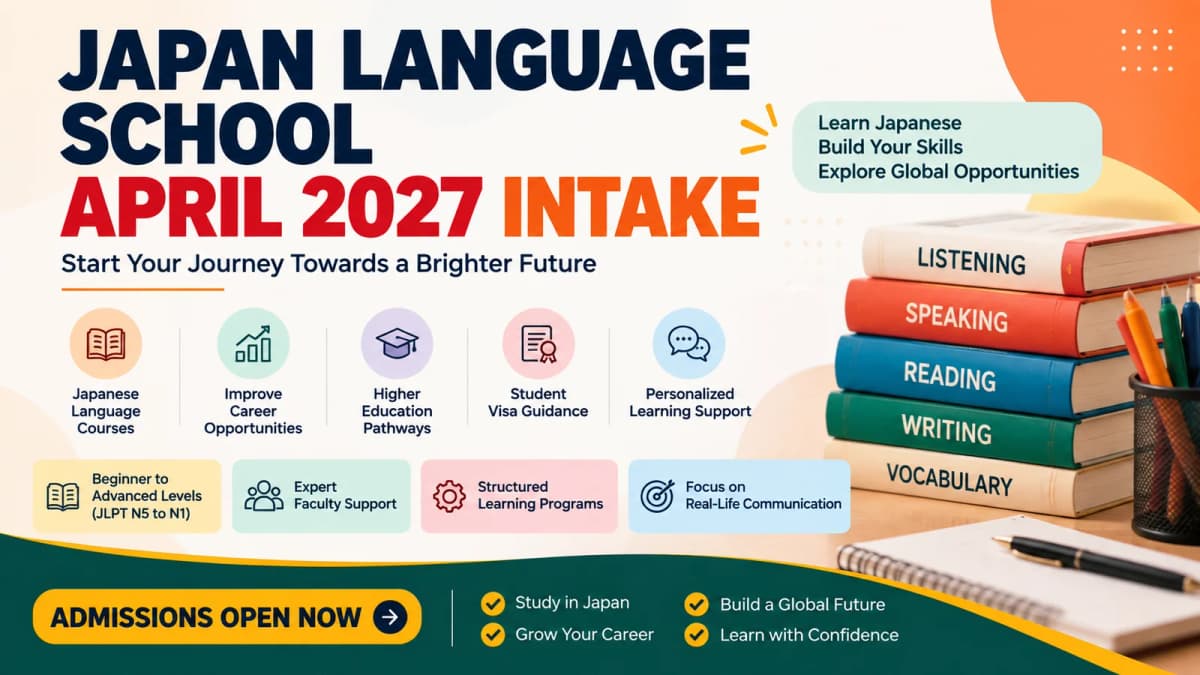
Japan Language School April 2027 Intake
Published: 2026-09-28 09:48:52
Quick answer: The April 2027 intake is the biggest and most popular intake for Indian students who want to study Japanese in Japan. For most schools, document submission runs from August to October 2026, immigration review runs from December 2026 to February 2027, and classes start in early April 2027. You need to be 18+, 12th pass or higher, show basic Japanese (usually JLPT N5) and have a sponsor with enough funds. The time to start is now.
Japan Language School April 2027 Intake
Every year, thousands of Indian students dream of studying in Tokyo, Osaka or Fukuoka. The Japanese language school route is the simplest way to begin. You learn the language, experience Japanese life, and then move on to a university, a vocational school or a job.
Let's begin with the basics. A Japanese language school is an immigration-approved institute where international students study Japanese full time for 6 months to 2 years on a student visa. The school sponsors your visa, so choosing the right school and applying on time is very important.
Why is April 2027 special? Japan's academic year starts in April. That is why the April intake is the largest one, and why schools open applications early. Since today is late September 2026, the document window for April 2027 is already open (or closing soon) at many schools.
Here is a quick snapshot of what this article covers:
| Topic | What You Will Learn |
| Dates & Timeline | When to apply, deadlines, COE dates |
| Eligibility | Age, education, Japanese level, study gap, finance |
| Documents | Full checklist for Indian students |
| Fees | Tuition, admission fee, living costs |
| Process | 6 simple steps from school selection to departure |
| Visa | Student visa and COE explained |
| Cities & Careers | Where to study and what to do after |
| TLS Support | How Team Language Services guides you |
Need help right now? Speak to our counsellors at TLS.
Visit Us 2/81-82, 2nd Floor, Lalita Park, Gali No - 2, Laxmi Nagar, New Delhi - 110092
Call Us +918700956038
Email Us: tls@teamlanguages.com
Why Choose the April 2027 Intake to Study Japanese in Japan?
Before we look at dates and documents, let's understand why so many students prefer April over the other intakes.
Japan offers four intakes a year: January, April, July and October. April is the main intake because it matches the Japanese school and university calendar.
Benefits of the April Intake for Indian Students
The April intake has some real advantages, especially for students coming after 12th or graduation.
- More seats and more school choices. Most schools offer their largest batches in April.
- Better timing for further studies. After 1.5 to 2 years of language study, you can enter a university or vocational school in the next April.
- Long preparation window. Applications start around August, so you have time to learn Japanese and collect documents.
- Cherry blossom season. You arrive in Japan in spring, which makes settling in easier and more enjoyable.
- Strong peer group. Larger classes mean you meet students from many countries.
Academic Opportunities and Career Prospects in Japan
Language school is not the end goal. It is the first step towards bigger opportunities.
After language school, students usually take one of these paths:
| Path | What It Means |
| Japanese university | Apply for undergraduate or graduate programs (often using JLPT N2 and EJU) |
| Vocational school (Senmon Gakko) | Job-focused training in IT, hospitality, design, etc. |
| Job in Japan | Work visa after finishing studies; N3 or N2 opens more doors |
| Scholarships | MEXT and other programs for higher studies |
Read more in our guides on study in Japan, work in Japan from India and scholarships for Indian students to study in Japan.
Japanese Language Study and Cultural Immersion
Studying in Japan is very different from studying Japanese in India, because you live the language every day.
In class, you learn reading, writing, listening and speaking. Outside class, you use Japanese at the station, in supermarkets, at part-time jobs and with friends. Most students improve much faster than they would in classes at home. Schools also organise cultural activities like tea ceremony, festivals and day trips.
Japan Language School April 2027 Intake: Important Dates and Application Timeline
Timing decides everything in Japan's student visa system, so let's look at the calendar carefully.
Japanese immigration accepts student visa applications only for set intakes, and deadlines are strict. Missing a deadline, even by a day, can push you to the next intake.
When Do Applications Open for April 2027?
Most schools begin accepting applications about 8 to 9 months before classes start.
Applications for April 2027 usually open from around July to August 2026, and most schools collect documents between August and October 2026. Some schools close early when seats fill up, so do not wait.
Japan Language School Application Deadlines
Deadlines differ from school to school, but the pattern is very similar.
| Stage (April Intake) | Typical Timing |
| Send documents and fee to school | August to October 2026 |
| School translates and checks documents | October to November 2026 |
| School submits to Immigration in Japan | End of November 2026 |
| Immigration review | December 2026 to February 2027 |
| COE issued | End of February 2027 |
| Pay balance fees and receive admission papers | Early to mid March 2027 |
| Visa application at embassy or consulate | Mid-March 2027 |
| Travel to Japan and start classes | Early April 2027 |
Note: This timeline is based on the general schedule followed by established schools. Your school may set an earlier cut-off. Always confirm.
Certificate of Eligibility (COE) Processing Timeline
The COE is the most important document in your entire journey, so let's see how long it takes.
The COE is issued by the Immigration Services Agency of Japan after the school applies on your behalf. For the April intake, the review normally runs from December to February, with COEs generally issued by the end of February. After payment of the remaining fees, the school sends the COE and admission certificate to you, usually in March. Learn more on our COE page and timeline page.
When Should Indian Students Start Applying?
Short answer: as early as possible.
| Your Current Situation | What You Should Do |
| Already know N5 or higher | Contact schools immediately and start documents |
| Learning Japanese now | Try to clear N5 (or a NAT-TEST equivalent) quickly; otherwise target July 2027 |
| Complete beginner | Start a fast-track N5 course now and consider July or October 2027 |
If you cannot make the April deadline, do not worry. You can target the July 2027 or October 2027 intake without losing a year.
Visit Us 2/81-82, 2nd Floor, Lalita Park, Gali No - 2, Laxmi Nagar, New Delhi - 110092
Call Us +918700956038
Email Us: tls@teamlanguages.com
Eligibility Criteria for Japan Language School April 2027 Intake
Now that you know the dates, let's check whether you are eligible.
Each school has its own rules, but most follow common immigration guidelines. The sections below explain each point in simple words.
Educational Qualifications
The basic rule is that you must have finished 12 years of schooling.
- Class 12 pass (or equivalent) is the minimum.
- Diploma, graduation or post-graduation students are also eligible.
- Your final school or college certificate must be genuine and verifiable.
Age Requirements for Indian Students
Age matters for both the school and the visa officer.
Most schools accept students who are 18 years or older. There is usually no strict upper limit, but the older you are, the more clearly you need to explain your study plan and future goals.
Japanese Language Proficiency Requirements (JLPT N5/N4)
This is the point students ask about the most.
Most schools expect JLPT N5 or equivalent ability, or proof of around 150 hours of Japanese study. Some well-known schools do not accept applicants below N5. Higher levels such as N4 make your file stronger and help you settle in faster.
| Proof of Japanese | Commonly Accepted? |
| JLPT N5 / N4 / higher | Yes, the most widely accepted |
| NAT-TEST Level 5 or higher | Yes, at many schools |
| J.TEST (Level F or higher) | Yes, at many schools |
| JFT-Basic (A2) | Accepted by some |
| Certificate of 150+ study hours | Accepted by many schools |
For details, read Japan student visa Japanese language requirements, JLPT N5 course and JLPT vs NAT test.
Study Gap and Academic Background Requirements
A study gap does not automatically mean rejection, but it must be explained honestly.
Many schools accept applicants with a gap, especially when the student can show what they did during that time (work, courses, family reasons, Japanese study). Keep these ready:
- Experience letters or job proof
- Course certificates
- A clear written explanation (in your statement of purpose)
Large or unexplained gaps increase the risk of refusal, so be transparent from the beginning. Gap limits differ by school, so ask before you apply.
Financial Eligibility and Sponsorship Requirements
Japan wants to be sure you can support yourself during your studies.
You need a guarantor (usually a parent or close relative) who can show stable income and savings. As a reference, one established Tokyo school asks for a bank balance of at least ¥1,600,000 (roughly ₹9 to 10 lakh, depending on the exchange rate) plus employment and tax documents. Other schools may ask for a different amount, so confirm with your school. See our guides on money required for Japan student visa and bank balance required.
Eligibility at a glance:
| Criteria | Typical Requirement |
| Age | 18 years or above |
| Education | 12th pass or higher |
| Japanese level | JLPT N5 or equivalent / about 150 hours |
| Study gap | Acceptable with valid explanation |
| Finance | Sponsor with proof of income and savings |
Documents Required for Japan Language School Admission 2027
Once you are eligible, the next task is to prepare a clean and complete document set.
Documents are the backbone of your application. Mistakes here are the most common reason for delays, so take your time and keep everything consistent.
Academic Certificates and Mark Sheets
These prove your education background.
- Class 10 and Class 12 certificates and mark sheets
- Graduation or diploma certificates (if any)
- Final diploma or degree certificate
Passport and Identity Documents
Your identity documents must match everywhere.
- Valid passport (photo page and other relevant pages)
- Passport-size photographs (school-specified size, commonly 4 cm x 3 cm)
- Aadhaar or other ID, if the school asks
Make sure the spelling of your name and date of birth is the same in all documents.
Japanese Language Certificates
This is your proof of language ability.
- JLPT N5/N4 certificate or score report
- NAT-TEST or J.TEST result (if taken)
- Certificate of Japanese study hours from a recognised institute
Bank Statements and Sponsor Documents
These show that you can afford your stay in Japan.
- Bank balance certificate of the sponsor
- Sponsor's employment certificate or business proof
- Income tax returns or income certificate
- Proof of relationship (birth certificate, family record)
Statement of Purpose and Application Forms
Your SOP tells the school and immigration why you want to study in Japan.
- School application form and personal record
- Letter of expenses payment (school format)
- Statement of Purpose explaining why Japan, why this school, and what you plan after language school
Complete checklist:
| Category | Documents |
| Academic | 10th, 12th, graduation certificates |
| Identity | Passport, photos |
| Language | JLPT/NAT/J.TEST certificate or study-hour proof |
| Financial | Bank certificate, income proof, relationship proof |
| Forms | Application form, SOP, expense letter |
For a detailed list, visit our documentation page or read the Japan student visa requirements guide.
Japan Language School Fees for April 2027 Intake
Money is a major concern for every Indian family, so let's break the costs down clearly.
Fees depend on the school, city and course length. The figures below are general estimates to help you plan. Always get a written fee structure from your chosen school.
Tuition Fees for Japanese Language Schools
Tuition is the biggest part of your school cost.
For a one-year course, tuition at most Japanese language schools typically falls in the range of roughly ¥600,000 to ¥800,000 per year. Tokyo schools are often a little higher than schools in Fukuoka or Saga. A two-year course costs roughly double.
Admission Fees and Other Application Charges
Apart from tuition, schools charge some one-time fees.
| Fee Type | Typical Range (Approx.) |
| Application / screening fee | ¥20,000 to ¥30,000 |
| Admission / registration fee | ¥20,000 to ¥60,000 |
| Facility / maintenance fee | ¥20,000 to ¥60,000 per year |
| Textbooks, insurance, activities | Varies by school |
Accommodation and Living Expenses in Japan
Your monthly budget depends heavily on the city you choose.
| Expense | Tokyo / Osaka (Monthly, Approx.) | Fukuoka / Saga (Monthly, Approx.) |
| Rent (dorm / share house) | ¥40,000 to ¥70,000 | ¥25,000 to ¥45,000 |
| Food | ¥25,000 to ¥40,000 | ¥20,000 to ¥30,000 |
| Transport and phone | ¥8,000 to ¥15,000 | ¥5,000 to ¥10,000 |
| Health insurance and others | ¥3,000 to ¥8,000 | ¥3,000 to ¥8,000 |
Part-time work (up to 28 hours a week after permission) can cover a good part of living costs, but do not depend on it fully in the first months.
Total Estimated Cost of Studying in Japan from India
Let's combine everything to see the bigger picture.
| Cost Head | Estimated First-Year Amount |
| School fees (tuition + admission + other) | ¥800,000 to ¥1,100,000 |
| Living costs (12 months) | ¥1,000,000 to ¥1,500,000 |
| Flight, visa, insurance, setup | ₹1 to ₹1.5 lakh approx. |
| Overall (rough) | About ¥1.8 to ¥2.6 million |
These are only estimates. Read our cost of studying in Tokyo for Indian students, Japan student visa cost and fees and Japan visa assistance fees pages for more.
Visit Us 2/81-82, 2nd Floor, Lalita Park, Gali No - 2, Laxmi Nagar, New Delhi - 110092
Call Us +918700956038
Email Us: tls@teamlanguages.com
Step-by-Step Application Process for Japan Language School April 2027
Now let's put everything together into one simple, easy-to-follow process.
Step 1: Choose the Right Japanese Language School
Your school choice affects your visa, your cost and your future.
Check that the school is recognised by Japan's Immigration Services Agency, and look at its location, fees, class size, support for further study and student reviews. Compare at least 3 to 4 schools.
Step 2: Check Eligibility and Prepare Documents
Get your paperwork and language proof ready before you apply.
Confirm the school's Japanese requirement, gather all documents from the checklist, and arrange translations if needed. Start Japanese classes if you have not yet reached N5.
Step 3: Apply for Admission and Attend the School Interview
Most schools hold a short interview, often online.
The interview is usually in simple Japanese or English. Expect questions about your background, why you want to study in Japan, your plans after language school, and your sponsor. Practise your introduction in advance with our self-introduction in Japanese guide.
Step 4: Submit Documents for COE Processing
After you are accepted, the school prepares your file.
You send documents and the processing fee. The school checks, translates and submits them to the Immigration Office in Japan (typically around the end of November for the April intake).
Step 5: Receive Your COE and Apply for a Japan Student Visa
The COE is your green signal.
Once the COE is issued (around February), you pay the remaining fees, receive your admission certificate and COE, and apply for the student visa at the Japanese embassy or consulate.
Step 6: Prepare for Departure to Japan
The final step is getting ready for your new life.
Book flights, arrange accommodation, get travel insurance, carry copies of important documents and learn basic survival Japanese.
Process summary:
| Step | Action | Approx. Time |
| 1 | Choose school | Now |
| 2 | Prepare documents and eligibility | Aug to Oct 2026 |
| 3 | Apply and interview | Aug to Oct 2026 |
| 4 | COE application | Oct to Nov 2026 |
| 5 | COE and visa | Feb to Mar 2027 |
| 6 | Departure | Early April 2027 |
Also read: how to apply for a Japan student visa and the application process page.
Japan Student Visa Requirements for April 2027 Intake
Let's now look at the visa itself, because this is where many students feel nervous.
Students who plan to study for 6 months or more need a student visa. Only the four intakes (January, April, July, October) are available for the long-term route.
Student Visa Application Process for Indian Students
The process is school-led, so your school handles most of the work.
- You submit documents to the school.
- The school applies for your COE.
- You apply for the visa at the Japanese embassy or consulate with your COE.
- You receive the visa and travel to Japan.
See our Japan student visa process for Indian students and is Japan student visa easy to get guides.
Certificate of Eligibility (COE) and Its Importance
Without a COE, the student visa process cannot move forward.
The COE proves that Japanese immigration has checked your school, finances and study plan. With a COE, the embassy visa step is usually much quicker. Read the Certificate of Eligibility Japan guide.
Financial Documents and Visa Interview Preparation
Keep your money documents clear and consistent.
- Bank statements should match the income and tax proof.
- Avoid sudden large deposits without explanation.
- Be ready to explain your plan for Japan, your school choice and your sponsor's income in a confident and honest way.
Common Reasons for Visa Delays and Application Errors
Most problems are avoidable if you know them in advance.
| Common Problem | How to Avoid It |
| Late submission | Apply in the August to October window |
| Name or date mismatch | Check every document carefully |
| Weak financial proof | Use clear, well-documented sponsor papers |
| Unexplained study gap | Provide proof and a clear explanation |
| Very low Japanese ability | Clear N5 or N4 before applying |
| Wrong agent or school | Choose recognised schools and transparent advisors |
Best Cities in Japan for International Language Students
The city you choose changes your budget, lifestyle and opportunities.
Study Japanese in Tokyo
Tokyo is the top choice for students who want maximum options.
Tokyo offers the most schools, the most part-time jobs and the strongest job market. It also has the highest living costs, so plan your budget accordingly.
Study Japanese in Osaka
Osaka is friendly, lively and slightly cheaper than Tokyo.
Osaka is known for its food, warm culture and strong business environment, with lower rent than Tokyo and a big international student community.
Study Japanese in Fukuoka
Fukuoka is popular for its balance between city life and affordability.
Fukuoka is known for lower living costs, good public transport and a growing startup scene, and it is often described as a student-friendly city.
Study Japanese in Saga
Saga suits students who want a quiet, low-cost environment.
Saga has very low living costs and a close community, which helps you practise Japanese every day. It offers fewer part-time job options than large cities.
| City | Cost of Living | Job Options | Best For |
| Tokyo | High | Very high | Career-focused students |
| Osaka | Medium to high | High | Balanced lifestyle |
| Fukuoka | Medium | Medium to high | Budget with city life |
| Saga | Low | Limited | Savings and focus on studies |
Career Opportunities After Completing a Japanese Language Course in Japan
Language school opens many doors, so let's see what comes next.
Higher Education Opportunities in Japanese Universities
Many students use language school as a bridge to a degree.
With JLPT N2 and, where required, EJU scores, students apply to Japanese universities and graduate schools. Read our guides on EJU exam registration and MEXT scholarship.
Job Opportunities in Japan for Indian Students
Japan has a strong need for skilled, Japanese-speaking professionals.
Popular fields include IT, engineering, hospitality, tourism, translation and customer support. Japanese ability at N3 or N2 makes you much more employable. See how to get a job in Japan after JLPT and jobs in India for Japanese language speakers.
Part-Time Work Opportunities While Studying
Part-time work helps with expenses and language practice.
Student visa holders can work up to 28 hours per week after obtaining permission. Common jobs are in restaurants, convenience stores and hotels. Your classes and attendance must always come first.
Japanese Language Proficiency and Career Growth
The higher your level, the better your options.
| JLPT Level | What It Helps You Do |
| N5 | Start language school; basic daily needs |
| N4 | Everyday conversation; better part-time options |
| N3 | Broader job options; entry to some vocational schools |
| N2 | University admission; most corporate jobs |
| N1 | Advanced professional roles |
Explore career after learning Japanese language and salary after JLPT N2.
Visit Us 2/81-82, 2nd Floor, Lalita Park, Gali No - 2, Laxmi Nagar, New Delhi - 110092
Call Us +918700956038
Email Us: tls@teamlanguages.com
Why Choose Team Language Services for Japan April 2027 Intake?
After understanding the process, the most important question is: who will guide you?
TLS: The Japanese Language School (Team Language Services), based in Laxmi Nagar, New Delhi, helps students learn Japanese and move step by step towards studying in Japan. Here is how TLS supports each stage of your journey.
Japanese Language Training from N5 to N1
Strong language skills make your application and your life in Japan much easier.
TLS offers structured courses for every level: N5, N4, N3, N2 and N1, plus conversation classes and an online Japanese course for students outside Delhi.
Japan Language School Admission Guidance
Choosing the right school is easier with expert help.
Our counsellors help you understand school types, cities, budgets and intake dates, so you can shortlist schools that match your profile. Learn more on our Japan study guidance page and admission page.
Student Visa and COE Application Assistance
Documentation is where most students need the most support.
TLS guides you through the visa application, document preparation and COE process, and helps you understand the timeline. Visit the full Japan visa assistance section.
Japanese Language and School Interview Preparation
Confidence in the interview can make a real difference.
We help you practise self-introduction, common school interview questions and basic conversation through Kaiwa practice and speaking classes.
Pre-Departure Guidance for Indian Students
Your preparation should not stop when the visa arrives.
TLS shares practical guidance on what to carry, how to plan your first weeks, basic survival Japanese and what to expect in Japanese daily life.
TLS support at a glance:
| Need | TLS Support |
| Learn Japanese | N5 to N1 courses, online and offline |
| Choose a school | Counselling and admission guidance |
| Documents | Checklist and document preparation help |
| COE and visa | Application and COE guidance |
| Interview | Practice sessions and speaking training |
| Before departure | Pre-departure tips and support |
Frequently Asked Questions About Japan Language School April 2027 Intake
Here are clear answers to the questions Indian students ask us most often.
Is April 2027 intake open for Japanese language schools?
Yes. Most schools started accepting April 2027 applications from around mid-2026, and document submission generally runs from August to October 2026. Since seats are limited, apply early.
What is the last date to apply for April 2027 intake?
There is no single national date. Each school sets its own cut-off, usually around October to early November 2026, so that documents can reach immigration by the end of November. Confirm the exact date with your school.
When should I apply for April intake in Japan?
Ideally between July and October 2026. Applying at least 6 to 8 months before April gives you time to fix documents and improve your Japanese. The earlier you apply, the safer your application is.
How can I get admission in Japanese language school in Japan?
Choose a recognised school, check its eligibility rules, prepare your documents (academic, identity, financial and Japanese language proof), submit your application and pass the school interview. After acceptance, the school applies for your COE and you apply for the student visa. TLS guides you through every step.
Can Indian students apply without knowing Japanese?
It depends on the school. Many schools require JLPT N5 or about 150 hours of study, and some do not accept complete beginners. If you know no Japanese yet, start an N5 course now and target the July or October 2027 intake if needed.
Is JLPT N5 mandatory for Japan language school admission?
It is not always a legal rule, but most schools ask for it or for equivalent proof (NAT-TEST, J.TEST or 150 study hours). Having N5 makes your application much stronger.
How long does it take to attend language school in Japan?
Most courses run from 6 months to 2 years. Students who plan to enter a university or vocational school usually study for 1.5 to 2 years, while students who only want to improve their Japanese may choose a shorter program. A student visa is needed for courses of 6 months or more.
How much does it cost to study Japanese in Japan?
Roughly ¥1.8 to ¥2.6 million for the first year, including tuition, fees and living costs. Costs are lower in cities like Fukuoka and Saga than in Tokyo.
How long does the Japan student visa process take?
The full process, from sending documents to travelling, takes around 7 to 8 months for the April intake (August to early April). The COE review alone runs from December to February.
Can students work part-time while studying in Japan?
Yes, up to 28 hours per week after obtaining permission, subject to visa rules and good attendance.
Can I get a scholarship to attend a Japanese language school in Japan?
Scholarships for language schools are limited compared with universities. Some options include JASSO scholarships for privately financed international students (for selected students, based on attendance and performance), and scholarships or fee reductions offered by individual schools or local governments. Government programs like MEXT are mainly for university and higher studies, so many students use language school to prepare for them. Check current details with your school and official sources, and read our MEXT scholarship guide.
Can students with a study gap apply for April 2027 intake?
Often yes, if the gap is explained with valid proof such as work experience, courses or family reasons. Acceptance limits vary by school.
How can Team Language Services help with Japan admission?
TLS offers Japanese language training from N5 to N1, admission guidance, document preparation, COE and visa assistance, interview practice and pre-departure support, all in one place.
Apply for Japan Language School April 2027 Intake with Team Language Services
You now know the dates, eligibility, documents, fees and process. The next step is action.
The April 2027 intake window is open right now, and the best applications are built early. At TLS: The Japanese Language School, we combine Japanese language training with admission guidance, so you improve your language and your application at the same time.
What you get with TLS:
- Level assessment and a personal plan for your target intake
- Japanese classes from N5 to N1 (online and offline)
- Help with shortlisting schools and understanding fees
- Application assistance and document preparation
- COE guidance and visa interview preparation
- Pre-departure guidance for Indian students
Take the Next Step
- Book your free counselling and demo class
- Explore all Japanese courses
- Talk to our Japan visa assistance team
- Contact us
- Check our course fees
Visit Us
TLS: The Japanese Language School (Team Language Services)
Visit Us 2/81-82, 2nd Floor, Lalita Park, Gali No - 2, Laxmi Nagar, New Delhi - 110092
Call Us +918700956038
Email Us: tls@teamlanguages.com